
No. A Texas cash-out refinance always requires a new appraisal. Section 50(a)(6) of the Texas Constitution requires a written acknowledgment of your home’s fair market value, and Fannie Mae explicitly prohibits appraisal waivers on these loans even when the automated underwriting system offers one. Appraisal-free refinancing does exist in Texas, but not on any loan that puts cash in your pocket.
That is the short answer. The longer answer is more useful, because the appraisal is not actually where most Texas homeowners lose time and money on a Texas cash-out refinance. This guide covers what the law requires, which no-appraisal paths are real, and what genuinely shortens your timeline.
What Is a No-Appraisal Refinance?
A no-appraisal refinance skips the step where a licensed appraiser establishes your home’s value. The lender relies on data it already holds instead. Skipping it can save several hundred to a couple of thousand dollars and remove one to three weeks from your closing timeline.
There are three separate paths, and people routinely confuse them. Only one of them is a true waiver.
Appraisal Waivers From Fannie Mae and Freddie Mac
Fannie Mae calls this value acceptance. When you apply, the lender runs your file through an automated underwriting system. If your property has a recent, reliable valuation in the agency’s database and your loan profile is strong, the system may offer to accept the stated value without a new appraisal.
Waivers are offered on a case-by-case basis on conventional loans. You cannot request one, shop for one, or qualify for one in advance. And on a Texas cash-out, the system will not issue one at all. More on that below.
FHA, VA, and USDA Streamline Refinances
Streamline programs let you refinance an existing government-backed loan into a new one with reduced documentation and usually no appraisal. The FHA Streamline and the VA Interest Rate Reduction Refinance Loan are the two most common.
The catch is built into the design. Streamline refinances exist to lower your rate or shorten your term, so they do not permit /get-fha-loans-with-dream-home/cash back. FHA Streamline allows up to $500 in incidental cash at closing from escrow adjustments, and that is the entire allowance. If your goal is accessing equity, streamline is not your program.
Automated Valuation Models and Desktop Reviews
An automated valuation model is software that estimates value from public records, tax assessments, and nearby sales. Lenders use AVMs constantly for internal purposes: pre-qualification, portfolio monitoring, and deciding whether to order a full appraisal.
An AVM figure is not an appraisal and does not satisfy a legal appraisal requirement. When a lender tells you they will “run an AVM first,” that is a preliminary check, not a substitute for the valuation your loan file ultimately needs.
Not sure how much equity you actually have?
Texas caps you at 80% of appraised value across all liens. We will run that number against your actual property before you spend anything on an application.
Dream Home Mortgage, NMLS #334616 | Brazos National Bank, NMLS #473879 | Equal Housing Lender. Not a commitment to lend.
Why a Cash-Out Refinance Without an Appraisal Is Not Allowed in Texas
Texas regulates home equity lending in its state constitution rather than in ordinary statute, which is unusual and is why the rules here are stricter than almost anywhere else in the country. Any loan that draws equity out of a Texas homestead is a Section 50(a)(6) transaction, and a fresh valuation is not optional in one.
What Section 50(a)(6) Requires
The constitution requires you and your lender to sign a written acknowledgment of the property’s fair market value as of the closing date. That acknowledgment has to rest on an actual appraisal, which is the mechanism that makes the 80% cap enforceable.
Fannie Mae’s selling guide closes the remaining gap directly: lenders must obtain a new appraisal on a Texas Section 50(a)(6) loan even when the automated system offers value acceptance. Freddie Mac applies the same restriction. So the waiver is not merely unlikely on a Texas cash-out. It is prohibited.
The 80% Limit and the 12-Day Waiting Period
The rules that shape a Texas cash-out, in full:
- 80% loan-to-value ceiling. Your new loan plus any other liens cannot exceed 80% of appraised value. You keep at least 20% equity.
- 12-day waiting period. At least 12 days must pass between your application and closing. There is no way to waive or shorten it.
- One every 12 months. You cannot close another cash-out on the same homestead within a year.
- Primary residence only. Second homes and rentals are not homesteads and fall outside 50(a)(6) entirely.
- 2% fee cap. Lender fees are capped at 2% of the loan amount. Notably, the appraisal fee is excluded from that cap, along with the survey, title insurance base premium, and per diem interest.
- The cap follows the property. Once you close a 50(a)(6), the 80% limit applies to every future refinance of that home, even one with no cash out.
The last point is the one homeowners most often discover too late, and it deserves real thought before you sign. The full rule set is covered in our guide to Texas cash-out refinance rules.
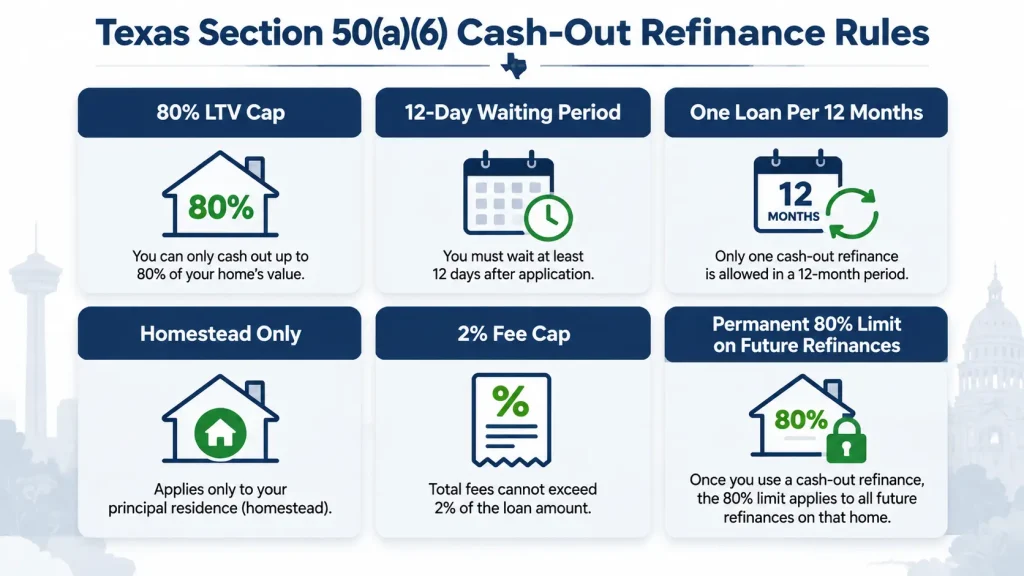
Texas Section 50(a)(6) sets six rules that no lender can waive.
Why FHA and VA Cash-Out Are Not Available in Texas
Texas limits cash-out refinancing on a homestead to conventional financing under 50(a)(6). Neither an FHA cash-out nor a VA cash-out is available on a Texas homestead, regardless of your service history or credit profile.
This trips people up because FHA and VA loans are otherwise widely available in Texas, and both agencies offer cash-out programs in other states. Rate-and-term refinancing under those programs remains available here, since it does not draw equity. Only the cash-out version is off the table.
Desktop and Hybrid Appraisals: Where They Actually Apply
You will find plenty of advice suggesting you ask your lender for a desktop or hybrid appraisal to speed up a Texas cash-out. It is worth understanding why that advice does not hold up here.
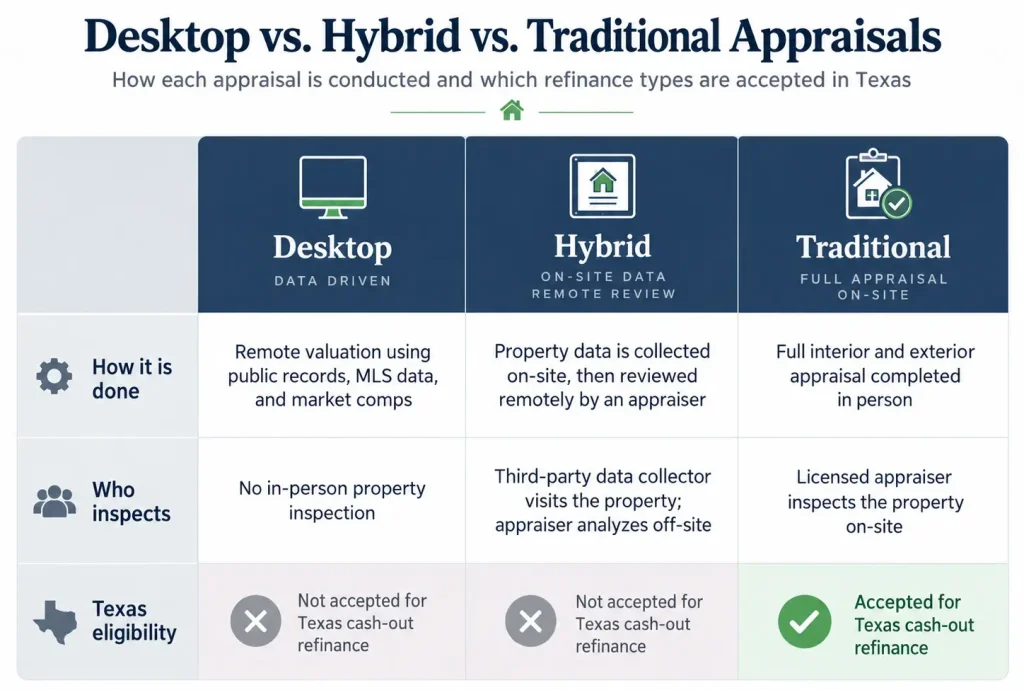
Only the traditional appraisal clears agency guidelines on a Texas 50(a)(6) loan.
Desktop Appraisal
A licensed appraiser develops an opinion of value from public records, MLS data, and photographs, without visiting the property. Faster and cheaper than a traditional appraisal, and common on low-risk rate-and-term refinances.
Hybrid Appraisal
A trained local inspector collects property data on site, then a licensed appraiser completes the valuation remotely. It splits the work to compress the schedule.
Traditional Appraisal
A licensed appraiser inspects the property and completes a full report. This is the standard product on a Texas cash-out refinance.
The practical reality: because agency guidelines prohibit value acceptance and value acceptance with property data on 50(a)(6) loans, reduced-scope products are generally not eligible either. Plan on a traditional appraisal. If a lender offers you a desktop or hybrid valuation on a Texas cash-out, ask them in writing which investor guideline permits it before you rely on the shorter timeline.
Desktop and hybrid options are real, and they are worth asking about. They apply when you are lowering your rate or shortening your term rather than pulling cash out. If that is your goal, you may have a genuinely appraisal-light path available. Compare it against your refinance options before assuming cash-out is the right structure.
No-Appraisal Refinance vs Texas Cash-Out Refinance
| Feature | No-Appraisal Refinance | Texas Cash-Out Refinance |
|---|---|---|
| Cash back allowed | No (FHA Streamline: $500 max) | Yes, up to 80% LTV |
| Appraisal required | Often waived | Always required |
| Minimum timeline | No statutory wait | 12-day waiting period |
| Eligible loan types | FHA, VA, USDA streamline; conventional with waiver | Conventional only |
| Property type | Varies by program | Texas homestead only |
| Frequency limit | None | Once every 12 months |
When a No-Appraisal Refinance Is the Right Move
If the appraisal requirement is what is holding you back, it is worth checking whether you need a cash-out at all. Two situations where the appraisal-free path fits cleanly:
You Want a Lower Rate or Shorter Term, Not Cash
Plenty of homeowners start researching cash-out because it is the term they know, when what they actually want is a lower payment. A rate-and-term refinance is a different transaction, it falls outside 50(a)(6), and it is where appraisal waivers and reduced-scope valuations actually become available. It also leaves your homestead free of the permanent 80% restriction.
You Already Have an FHA, VA, or USDA Loan
Streamline programs are built for exactly this. Reduced documentation, usually no appraisal, no income verification in many cases. If you hold government-backed financing and want a better rate, start here before looking at anything else.
And if you want cash but the 80% cap or the permanent restriction gives you pause, compare a home equity loan or HELOC instead. Those are separate products with their own Texas rules, and for smaller amounts they often work out better than restructuring your first mortgage.
What the Appraisal Actually Gets You
The appraisal is a required cost on a Texas cash-out, so it is worth understanding what you receive for it:
- A defensible current valuation rather than an estimate from an algorithm
- Protection against borrowing more than the property supports
- Potentially a larger loan amount, if your value has risen since purchase
- A documented basis for your loan terms
- A record that protects you in any later dispute over value
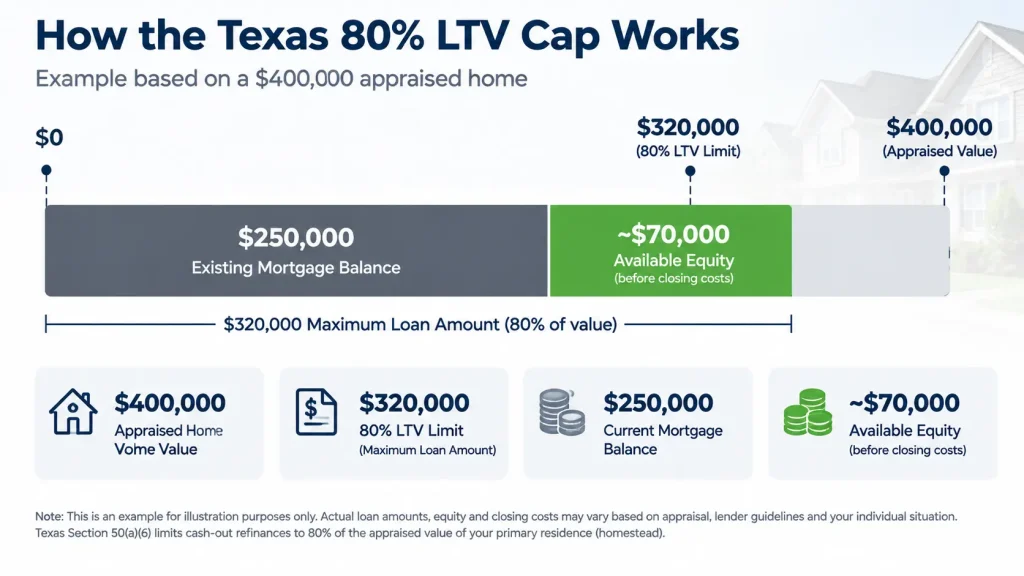
The appraised value sets your ceiling. Every other number follows from it.
Texas home values have moved substantially in most metros over the past several years, so a current appraisal frequently works in the homeowner’s favor. You can review recent sales near your property to get a rough sense of where you stand before you order anything.
How to Get Through the Appraisal Step Faster
The appraisal is fixed. Your cost and timeline are not. Homeowners in Houston and across Texas have real room to move here.
Before the Appraiser Arrives
- Have a list of improvements ready with dates and approximate costs, especially anything structural, mechanical, or permitted
- Handle small visible repairs. Cosmetic condition affects the report more than most people expect
- Make sure the appraiser can access every room, the attic, the garage, and the exterior
- Note recent comparable sales in your neighborhood, particularly any the appraiser might miss
What to Ask Your Lender
- How many business days between order and report delivery, on average
- Whether the 12-day waiting period starts at application or at disclosure delivery
- Which fees sit inside the 2% cap and which sit outside it
- Whether the appraisal is ordered up front or after conditional approval
That last question matters more than it sounds. Some lenders order the appraisal immediately and run underwriting in parallel; others wait for conditional approval and add a week. Same fee, materially different timeline.
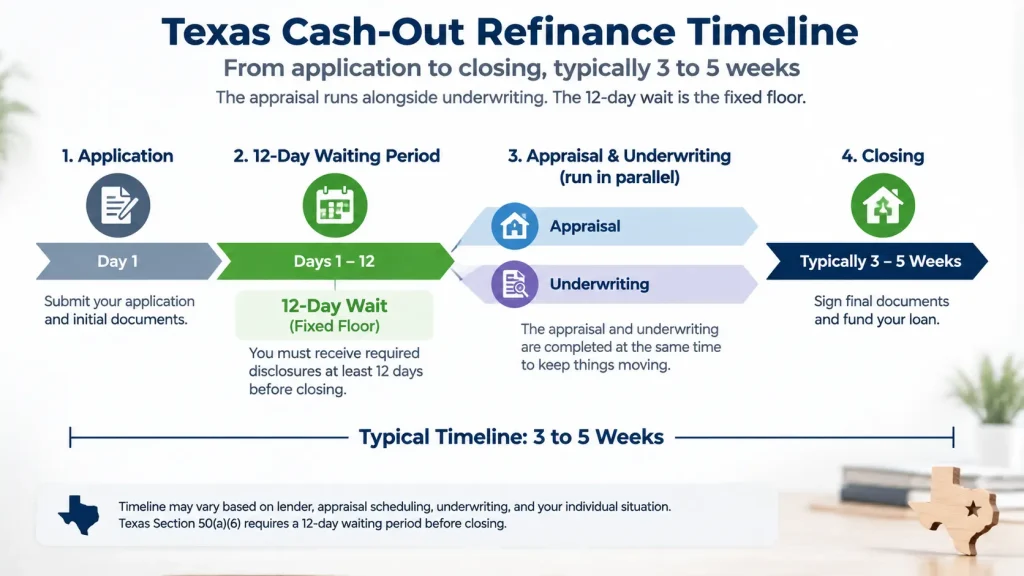
The appraisal runs alongside underwriting. The 12-day wait is the fixed floor.
How Rates and the September 2026 Fed Decision Affect Your Timing
On September 16, 2026, the Federal Reserve raised its benchmark rate by a quarter point to a target range of 3.75% to 4%, the first increase since 2023. The Federal Open Market Committee voted 12 to 0 under Chair Kevin Warsh, citing persistent inflation alongside a steady labor market. Most committee members now project at least one further increase before year end.
The Fed does not set mortgage rates. Mortgage pricing tracks the 10-year Treasury yield far more closely, and Treasury yields rose following the announcement. The practical implication for a refinance is directional rather than precise: the near-term path for rates is more likely up than down, which shortens the case for waiting.
Cash-out refinance pricing also carries a premium over rate-and-term, typically a quarter to a half point, because lenders price the added risk. For current pricing on your scenario, check today’s rates rather than relying on any published range, since these move daily.
One more consideration if your assets are not conventional: some Texas lenders now evaluate verified crypto holdings as qualifying income or reserves, which can change what you qualify for.
The appraisal is required. Overpaying for it is not.
We write Texas 50(a)(6) files every week and we will tell you honestly whether a cash-out or a rate-and-term refinance fits your situation better.
Dream Home Mortgage, NMLS #334616 | Brazos National Bank, NMLS #473879 | Equal Housing Lender. Not a commitment to lend.
Frequently Asked Questions
Can I get a cash-out refinance in Texas without an appraisal?
No. Section 50(a)(6) requires a written acknowledgment of fair market value, and both Fannie Mae and Freddie Mac prohibit appraisal waivers on these loans. This applies regardless of credit score, equity position, or lender.
Does a Texas cash-out refinance require an interior inspection?
Plan on a traditional appraisal that includes an interior and exterior inspection. Because agency guidelines prohibit value acceptance on 50(a)(6) loans, reduced-scope alternatives are generally not eligible. If a lender proposes one, ask which investor guideline permits it.
What is the fastest a Texas cash-out refinance can close?
The 12-day waiting period between application and closing is a constitutional floor with no exceptions. In practice most files close in three to five weeks once appraisal, underwriting, and title work are accounted for.
Can I do an FHA or VA cash-out refinance in Texas?
Not on a Texas homestead. Cash-out refinancing here is limited to conventional financing under 50(a)(6). FHA and VA rate-and-term refinances remain available, since they do not draw equity.
How much cash can I take out of a Texas home?
Up to 80% of appraised value, less your existing mortgage balance and any other liens. On a home appraising at $400,000 with a $250,000 balance, the ceiling is $320,000, leaving roughly $70,000 before closing costs. The limit is set by the state constitution and does not vary by lender.
What credit score do I need?
Most lenders look for 620 or higher on a Texas cash-out, with meaningfully better pricing above 700. Options may exist below 620 depending on equity and overall profile.
Can I use a home equity loan or HELOC to avoid the appraisal?
A valuation is still required, though some lenders accept alternative valuation products on smaller second-lien amounts. The stronger argument for a HELOC or home equity loan is that it leaves your first mortgage rate untouched, which matters if you are holding a rate well below current pricing.
Does the 80% cap apply to future refinances?
Yes. Once you close a 50(a)(6) on your homestead, the 80% limit applies to every subsequent refinance of that property, including rate-and-term refinances with no cash out. Factor this in before you close.
Talk to a Texas Cash-Out Refinance Specialist
The appraisal requirement on a Texas cash-out is not negotiable, and any lender suggesting otherwise is worth a second look. What is negotiable is which loan structure you choose, what you pay in lender fees, and how efficiently your file moves.
We work with homeowners in Houston, Dallas, Plano, and across Texas on these files every week. If a rate-and-term refinance or a home equity line serves you better than a cash-out, we will say so.
Schedule a consultation and we will review your numbers and give you a straight answer on your options.
Last updated September 18, 2026. Rules, rates, and agency guidelines described here reflect requirements in effect as of that date and are subject to change. This article is general information, not legal, tax, or financial advice. Loan approval is subject to underwriting; applicants may qualify, and no approval is guaranteed. Dream Home Mortgage, NMLS #334616. Brazos National Bank, NMLS #473879. Equal Housing Lender.
