
No. A Texas cash-out refinance always requires a new appraisal. A cash out refinance without appraisal is not available on any Texas loan that puts money in your pocket, because Section 50(a)(6) of the Texas Constitution requires a signed written acknowledgment of your home’s fair market value, and Fannie Mae prohibits appraisal waivers on cash-out refinances even when the automated system offers one.
Appraisal-free refinancing does exist in Texas. It just never exists on a loan that returns equity to you. That is the short answer, and it is the one most people come here for.
The longer answer is more useful, because the appraisal is not actually where most Texas homeowners lose time and money on a Texas cash-out refinance. Below is what the law requires, which no-appraisal paths are real, and what genuinely shortens a timeline.
What Is a No-Appraisal Refinance?
A no-appraisal refinance is a refinance that skips the step where a licensed appraiser inspects the property and establishes its value. The lender relies on valuation data it already holds instead. Skipping the appraisal may save several hundred to a couple of thousand dollars and remove one to three weeks from a closing timeline.
The appraisal is required. Overpaying for it is not.
We write Texas 50(a)(6) files every week and we will tell you honestly whether a cash-out or a rate-and-term refinance fits your situation better.
Dream Home Mortgage, NMLS #334616 | Brazos National Bank, NMLS #473879 | Equal Housing Lender. Not a commitment to lend.
There are three separate paths, and people routinely confuse them. Only one of them is a true appraisal waiver, and none of the three will hand you cash at closing.
1. Conventional Appraisal Waivers
Fannie Mae and Freddie Mac can offer a property valuation waiver when their automated underwriting systems already hold strong data on your home, usually from a recent prior appraisal. Waivers show up most often on rate-and-term refinances with solid equity and clean credit. They are offered by the system, not requested by you or your loan officer, and the lender still has the right to order an appraisal anyway.
2. Government Streamline Refinances
The FHA Streamline Refinance and the VA Interest Rate Reduction Refinance Loan (IRRRL) were built to skip the appraisal. Both require that you already hold an FHA or VA loan, and both limit you to lowering your rate or changing your term. The VA IRRRL permits a small amount of cash back only for energy-efficient improvements, which is not the same as tapping equity.
3. USDA Streamlined Assist
USDA borrowers in eligible rural areas can refinance an existing USDA loan without a new appraisal, again with no cash out.
| Path | Appraisal | Cash Out Allowed? |
|---|---|---|
| Conventional appraisal waiver | Often skipped | No |
| FHA Streamline | Not required | No |
| VA IRRRL | Not required | No (limited energy improvements only) |
| USDA Streamlined Assist | Not required | No |
| Texas 50(a)(6) cash-out | Always required | Yes |
The pattern is consistent. An appraisal exists to protect the lender from lending more than the home is worth. When you are only adjusting a rate or a term, the loan balance is not growing, so the risk of being wrong about value is small. The moment you pull equity out, the balance climbs and the value question becomes the center of the loan. That is when a current, independent opinion of value becomes non-negotiable.
Texas adds a second layer on top of that. The state constitution treats home equity lending as a consumer protection issue, not just a credit risk issue, so the appraisal requirement is written into law rather than left to lender discretion. No lender in Texas can waive it, price around it, or find a workaround, and anyone who tells you otherwise is describing a loan that is not a Texas cash-out refinance.
If your goal is cash, plan on the appraisal. If your goal is a lower payment, a no-appraisal path may be sitting right in front of you, and we can tell you in one conversation which one you qualify for.
Why Can’t You Get a Cash-Out Refinance Without an Appraisal in Texas?
You can’t. A cash-out refinance on a Texas homestead is a Section 50(a)(6) home equity loan, and state law requires the borrower and lender to sign a written acknowledgment of the property’s fair market value at closing. That value has to come from a new appraisal, so a cash out refi no appraisal is not an option here.
A Section 50(a)(6) loan is any mortgage that takes equity out of a Texas homestead, governed by Article XVI, Section 50 of the Texas Constitution rather than by ordinary statute. That placement is unusual, and it is why the rules in Texas are stricter than in almost any other state. Lenders cannot write around a constitutional provision the way they can adjust an internal overlay.
What Section 50(a)(6) Requires
The fair market value acknowledgment has to rest on an actual appraisal. That document is the mechanism that makes the 80% cap enforceable, because a cap on value means nothing without a value.
Agency guidance closes the remaining gap. Fannie Mae’s Selling Guide directs lenders to obtain a new appraisal on a Texas Section 50(a)(6) loan even when the automated underwriting system offers value acceptance, the program formerly called the appraisal waiver. The Freddie Mac Seller/Servicer Guide applies the same restriction. So a waiver on a Texas cash-out is not merely unlikely. It is prohibited.
Not sure how much equity you actually have?
Texas caps you at 80% of appraised value across all liens. We will run that number against your actual property before you spend anything on an application.
Dream Home Mortgage, NMLS #334616 | Brazos National Bank, NMLS #473879 | Equal Housing Lender. Not a commitment to lend.
The 80% Limit and the 12-Day Waiting Period
The rules that shape a Texas cash-out, in full:
- 80% loan-to-value ceiling. Your new loan plus any other liens cannot exceed 80% of appraised value. You keep at least 20% equity.
- 12-day waiting period. At least 12 days must pass between your application and closing. There is no way to waive or shorten it.
- One every 12 months. You cannot close another cash-out on the same homestead within a year of the last one, even if you have equity to spare.
- Closing location. You must sign at a title company office, a lender’s office, or an attorney’s office. Not at your kitchen table.
- Once a 50(a)(6), always a 50(a)(6). After you take a Texas cash-out, the property carries that designation. Any future refinance has to follow the same rules unless it qualifies as a Section 50(f)(2) rate-and-term conversion.
What This Means for Your Timeline
Plan on the appraisal, and plan on the 12 days. Together they set the floor for how fast a Texas cash-out can close, and no lender can move that floor. What we can control is everything else: ordering the appraisal early, getting your documents in once instead of three times, and keeping underwriting moving while the clock runs.
If you need funds quickly, tell us at the start. We will give you a realistic closing date rather than an optimistic one, and we will walk you through whether a cash-out is the right tool or whether a different structure fits your situation better.
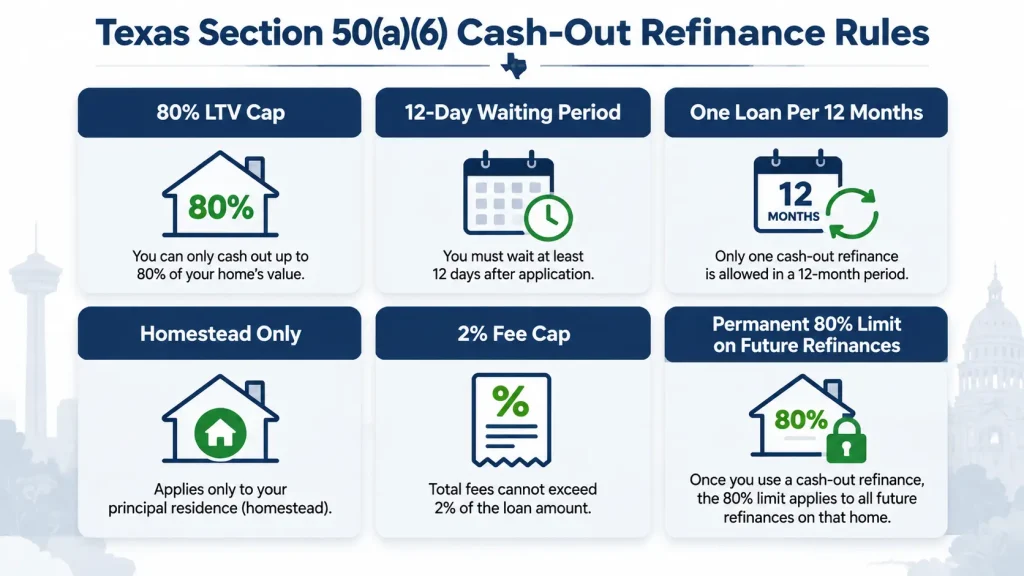
Texas Section 50(a)(6) sets six rules that no lender can waive.
Do desktop or hybrid appraisals work on a Texas cash-out refinance?
No. On a Texas 50(a)(6) cash-out, only a traditional interior appraisal clears agency guidelines. A desktop or hybrid valuation is a reduced-scope product, and because value acceptance and value acceptance plus property data are not permitted on Texas cash-out loans, the shorter-scope alternatives generally are not eligible either. Plan on a full appraisal.
Plenty of advice online suggests asking your lender for a desktop or hybrid appraisal to speed up a Texas cash-out. It is worth understanding why that advice does not hold up here, and what each product actually is.
What is a desktop appraisal?
A desktop appraisal is a valuation in which a licensed appraiser develops an opinion of value from public records, MLS data, and photographs, without visiting the property. It is faster and cheaper than a traditional appraisal, and it shows up most often on low-risk rate-and-term refinances.
What is a hybrid appraisal?
A hybrid appraisal splits the work. A trained local inspector collects property data on site, then a licensed appraiser completes the valuation remotely. The point of the structure is to compress the schedule without sending the appraiser out personally.
What is a traditional appraisal?
A traditional appraisal is a full report completed by a licensed appraiser who inspects the property in person. This is the standard valuation product on a Texas cash-out refinance, and you should budget for it.
If a lender offers you a desktop or hybrid valuation on a Texas cash-out, ask in writing which investor guideline permits it before you rely on the shorter timeline. Appraisal and appraisal waiver policy is published by the agencies themselves, so the answer should be easy to point to. Fannie Mae publishes its rules in the Selling Guide and Freddie Mac in the Single-Family Seller/Servicer Guide. Confirm current eligibility with your loan officer, since guideline updates are issued throughout the year.
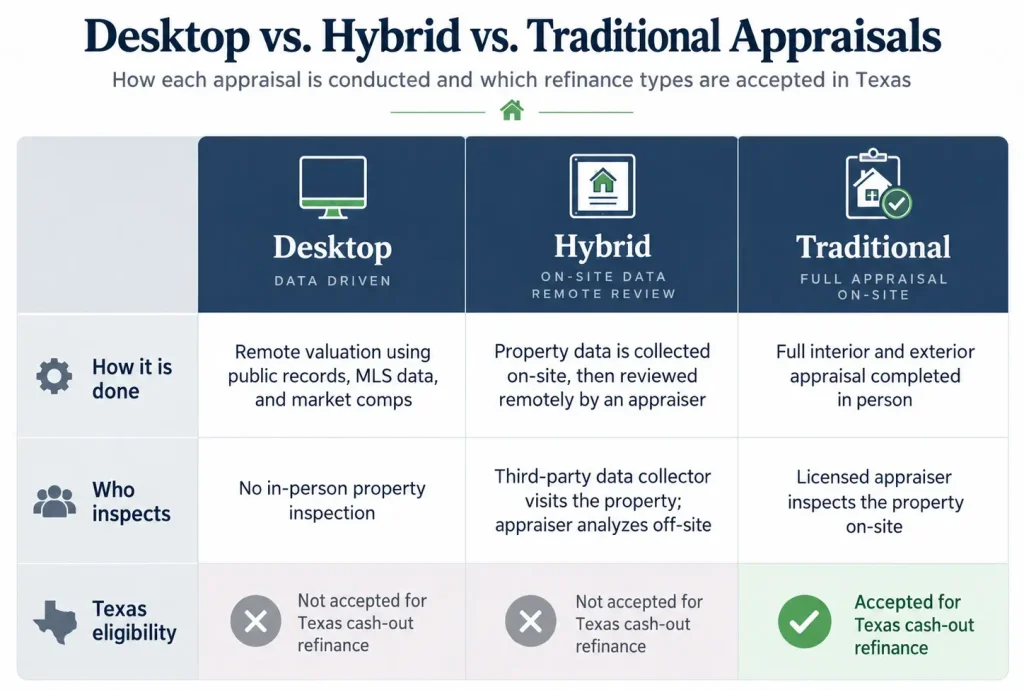
Only the traditional appraisal clears agency guidelines on a Texas 50(a)(6) loan.
Desktop and hybrid options are real, and they are worth asking about. They apply when you are lowering your rate or shortening your term rather than pulling cash out. If that is your goal, you may have a genuinely appraisal-light path available. Compare it against your refinance options before assuming cash-out is the right structure.
No-appraisal refinance vs Texas cash-out refinance: how do they compare?
The short version: a no appraisal refinance cash out does not exist in Texas. Appraisal-free programs are built for rate and term changes, not equity withdrawal. Here is how the two transactions line up side by side.
conventional rate-and-term with value acceptanceConventional 50(a)(6) only
Maximum loan-to-valueVaries by program, often based on existing loan balance80% of fair market value, no exceptionsFee limitsStandard program rulesCertain lender fees capped at 2% of the loan amount, with appraisal, survey, and title premiums excluded from the capBest forLowering your rate or shortening your termAccessing home equity for debt payoff, renovations, or reserves
Read the table as a decision tool rather than a scoreboard. Neither column is better. They answer different questions. If your goal is a lower payment and you already hold an FHA, VA, or USDA loan, the streamline path is usually faster, cheaper, and lighter on documentation. If your goal is cash in hand, the Texas cash-out rules apply in full, including the appraisal, the 80% ceiling, and the 12-day wait.
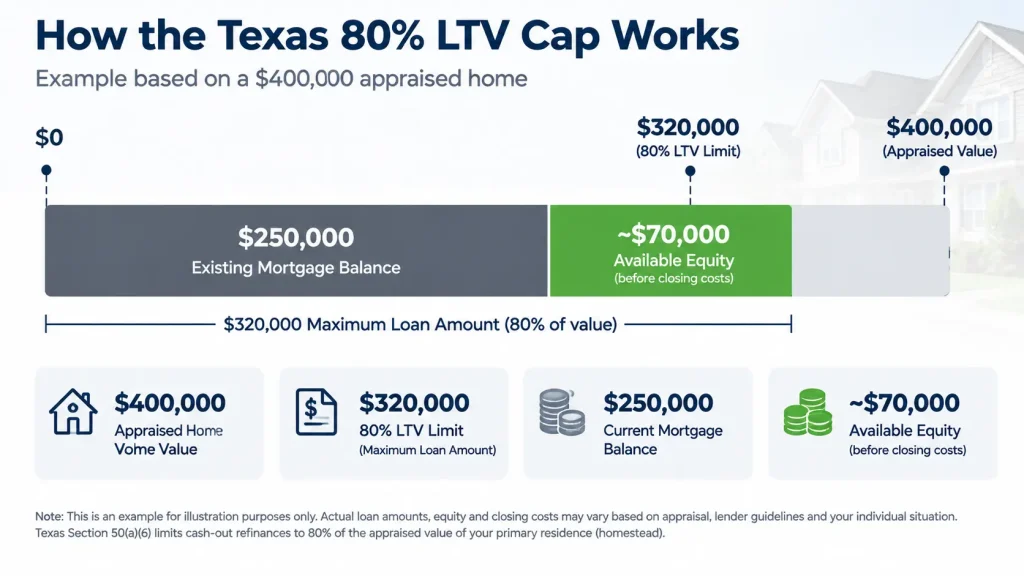
The appraised value sets your ceiling. Every other number follows from it.
One detail borrowers often miss: once you close a Texas 50(a)(6) loan, that loan stays classified as a cash-out under Texas law unless you later refinance it under the specific conditions the state allows. That classification can affect your future options, so it is worth discussing before you sign.
Not sure which column you belong in? That is a normal place to start. Talk it through with a DHM loan officer, and we will map your numbers against both paths before you commit to either one.
How can you move the appraisal step along faster?
You cannot skip the appraisal on a Texas cash-out refinance, but you can control what it costs you in time. Prepare the property, document your improvements, and ask your lender when the appraisal gets ordered. A file that is ready on day one usually moves through underwriting with fewer conditions.
A Texas cash-out refinance is a Section 50(a)(6) home equity loan, governed by Article XVI, Section 50 of the Texas Constitution. Those are the cash out refinance rules in Texas that set the 80% equity limit, the 2% fee cap, and the 12-day waiting period. Homeowners in Houston and across the state still have real room to move on cost and sequence.
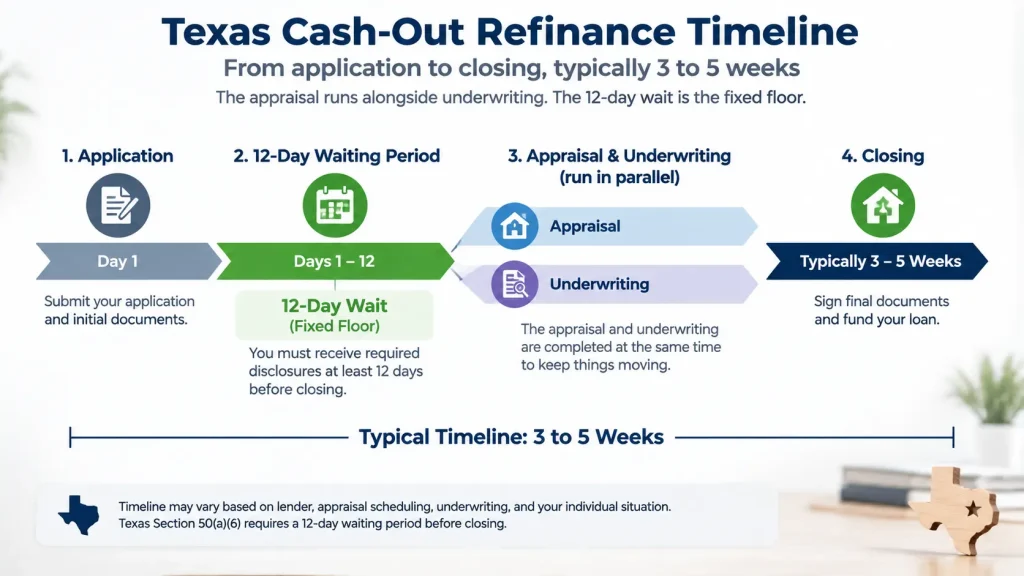
The appraisal runs alongside underwriting. The 12-day wait is the fixed floor.
What should you do before the appraiser arrives?
- Have a list of improvements ready with dates and approximate costs, especially anything structural, mechanical, or permitted
- Handle small visible repairs. Cosmetic condition affects the report more than most people expect
- Make sure the appraiser can access every room, the attic, the garage, and the exterior
- Note recent comparable sales in your neighborhood, particularly any the appraiser might miss
Under the ECOA Valuations Rule, your lender must give you a copy of the appraisal report. The Consumer Financial Protection Bureau explains your right to receive it, so ask for it and read it.
What should you ask your lender about the appraisal?
- How many business days pass between order and report delivery, on average?
- Does the 12-day waiting period start at application or at disclosure delivery?
- Which fees sit inside the 2% cap, and which sit outside it?
- Is the appraisal ordered up front, or after conditional approval?
That last question matters most. Some lenders hold the appraisal order until underwriting issues a conditional approval, which can add a week or more to your timeline for no real benefit. Others order it as soon as you lock and the 12-day clock starts, so the two run side by side instead of back to back.
Ask early, and ask plainly. If the answer is vague, that tells you something about how the rest of the file will be handled.
What slows a Texas cash-out appraisal down most often?
| Issue | What It Costs You | How to Avoid It |
|---|---|---|
| Scheduling delays with the appraiser | Several days to a week | Respond to the first contact attempt and offer flexible access times |
| Value comes in below expectations | Reduced cash out, or a restructured loan | Share improvement records and recent neighborhood sales up front |
| Missing permits on past work | Added underwriting conditions | Pull permit records before you apply |
| Limited access to parts of the home | A second trip and a new fee | Clear the attic hatch, garage, and all interior rooms |
None of this is complicated, but it does take a few hours of preparation. We would rather you spend that time now than wait on a reinspection later. If you want help reading your own equity position before you apply, reach out and we will walk through it with you.
Texas cash-out refinance FAQs
How much equity do I need for a cash-out refinance in Texas?
Texas law caps a cash-out refinance on a homestead property at 80% of the home’s fair market value. That means you must keep at least 20% equity in the home after closing, including any second liens that stay in place. If your home appraises at $400,000, your total mortgage debt after the refinance cannot exceed $320,000.
What is the 12-day waiting period?
Before you can close a Texas Section 50(a)(6) home equity loan, you must receive a written notice of your rights and wait at least 12 days before signing. This cooling-off period gives you time to review the terms without pressure. After closing, you also get a three-day right of rescission, so you can cancel the loan if you change your mind.
How often can I do a cash-out refinance in Texas?
Once every 12 months. The clock runs from the closing date of your last Texas home equity loan, not from the application date. If you closed a cash-out refinance in June, your next one cannot close until the following June at the earliest.
Are closing costs capped?
Yes. Certain fees paid to parties other than the lender are limited to 2% of the loan amount. Appraisal fees, survey costs, title insurance premiums, and title examination charges are excluded from that 2% cap. We will walk you through every line item so you know exactly what is counted and what is not.
Can I use a cash-out refinance on an investment property or second home?
Yes, and the Texas 50(a)(6) rules do not apply to non-homestead properties. Those loans follow standard conventional guidelines, which often allow different loan-to-value limits and fewer procedural requirements. Terms vary by lender and occupancy type, so ask us for a side-by-side comparison.
Can I ever get out of a Texas cash-out loan?
You can. Texas allows you to refinance an existing 50(a)(6) loan into a standard rate-and-term loan if you meet specific conditions, including taking no additional cash out, waiting at least 12 months from the original closing, and keeping the new loan at or below 80% loan-to-value. You must also receive a required written disclosure at least three business days before closing. these are the general timings consult your lender for your timings.
What can I use the money for?
Anything you choose. Most homeowners use the funds for debt consolidation, home improvements, tuition, business capital, or building a cash reserve. There is no restriction on how you spend the proceeds, though we will help you weigh whether the trade-off in rate and term makes sense for your goal.
Will a cash-out refinance raise my interest rate?
Often, yes. Cash-out loans typically price slightly higher than rate-and-term refinances because lenders view them as higher risk. The right question is not whether the rate goes up, but whether your overall monthly obligations go down once higher-interest debt is paid off. We run both numbers before you commit.
Talk through your options with us
Texas cash-out rules are strict, but they exist to protect your equity. With the right guidance, the process is straightforward and predictable. Tell us about your home value, current loan balance, and what you want the cash to accomplish, and we will show you what is realistically available, including the full cost over the life of the loan.
We work with homeowners in Houston, Dallas, Plano, and across Texas on these files every week. If a rate-and-term refinance or a home equity line serves you better than a cash-out, we will say so.
Schedule a consultation and we will review your numbers and give you a straight answer on your options.
Rules, rates, and agency guidelines described here reflect requirements in effect as of that date and are subject to change. This article is general information, not legal, tax, or financial advice. Loan approval is subject to underwriting; applicants may qualify, and no approval is guaranteed. Dream Home Mortgage, NMLS #334616. Brazos National Bank, NMLS #473879. Equal Housing Lender.
